
PGM XXXVI, 256-264
Date: 4th century
Findspot: Egypt (purchased in the Fayoum)
Current Location: University of Oslo Library Papyrus Collection, P.Oslo I 1
In this short ritual the practitioner inscribes a clay sherd with a brief invocation and the ritual’s goal. There is no uttered communication:
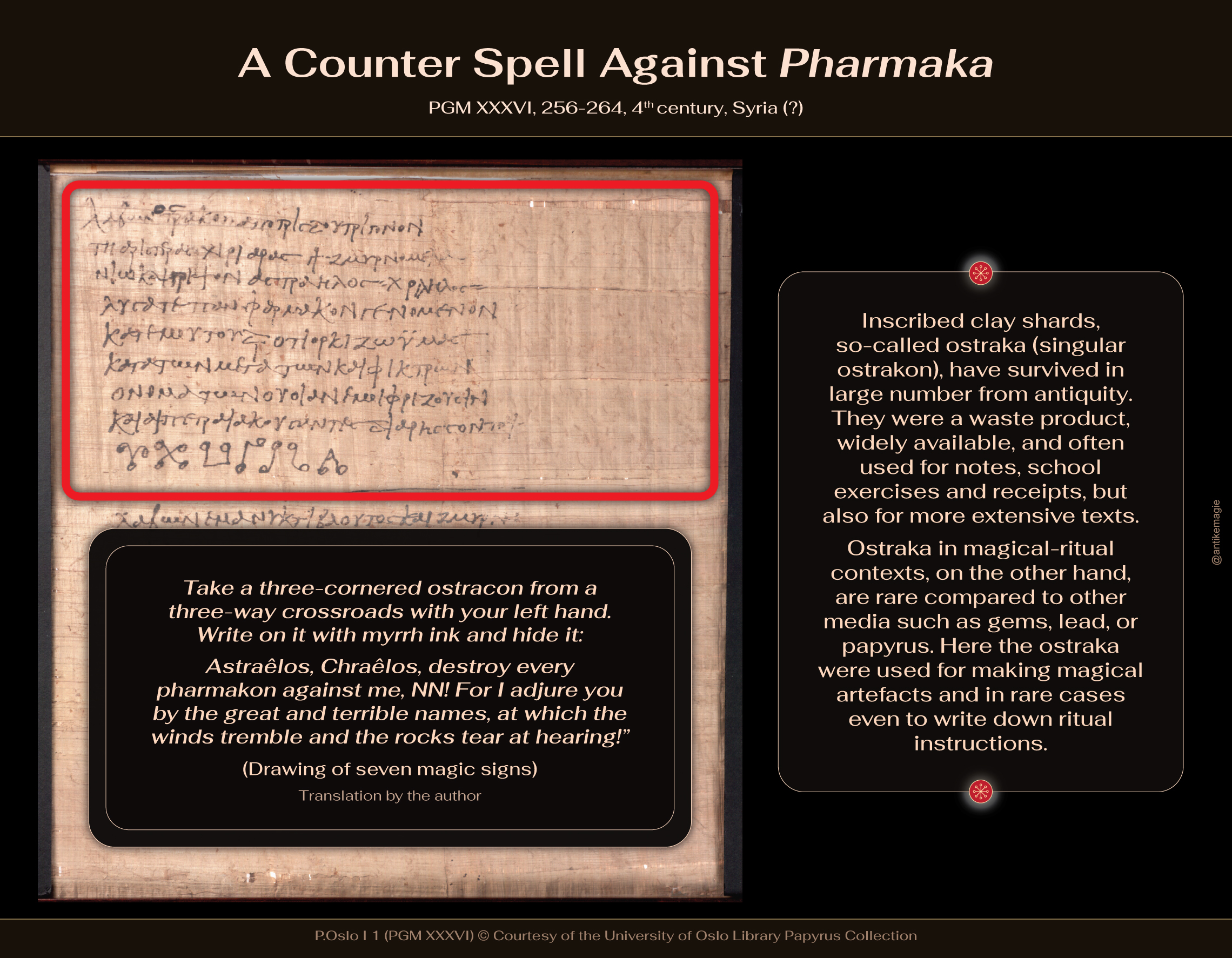
Take a three-cornered ostracon from a three-way crossroads with your left hand. Write on it with myrrh ink and hide it:
Astraêlos, Chraêlos, destroy every pharmakon against me, NN! For I adjure you by the great and terrible names, at which the winds tremble and the rocks tear at hearing!”
(Drawing of seven magic signs)
Translation by Kirsten D. Dzwiza
Inscribed clay shards, so-called ostraka (singular ostrakon), have survived in large number from antiquity. They were a waste product, widely available, and often used for notes, school exercises and receipts, but also for more extensive texts.
Ostraka in magical-ritual contexts, on the other hand, are rare compared to other media such as gems, lead, or papyrus. Here the ostraka were used for making magical artefacts and in rare cases even to write down ritual instructions.
Become my patron for more infographics, research and videos: https://www.patreon.com/ancientmagic