
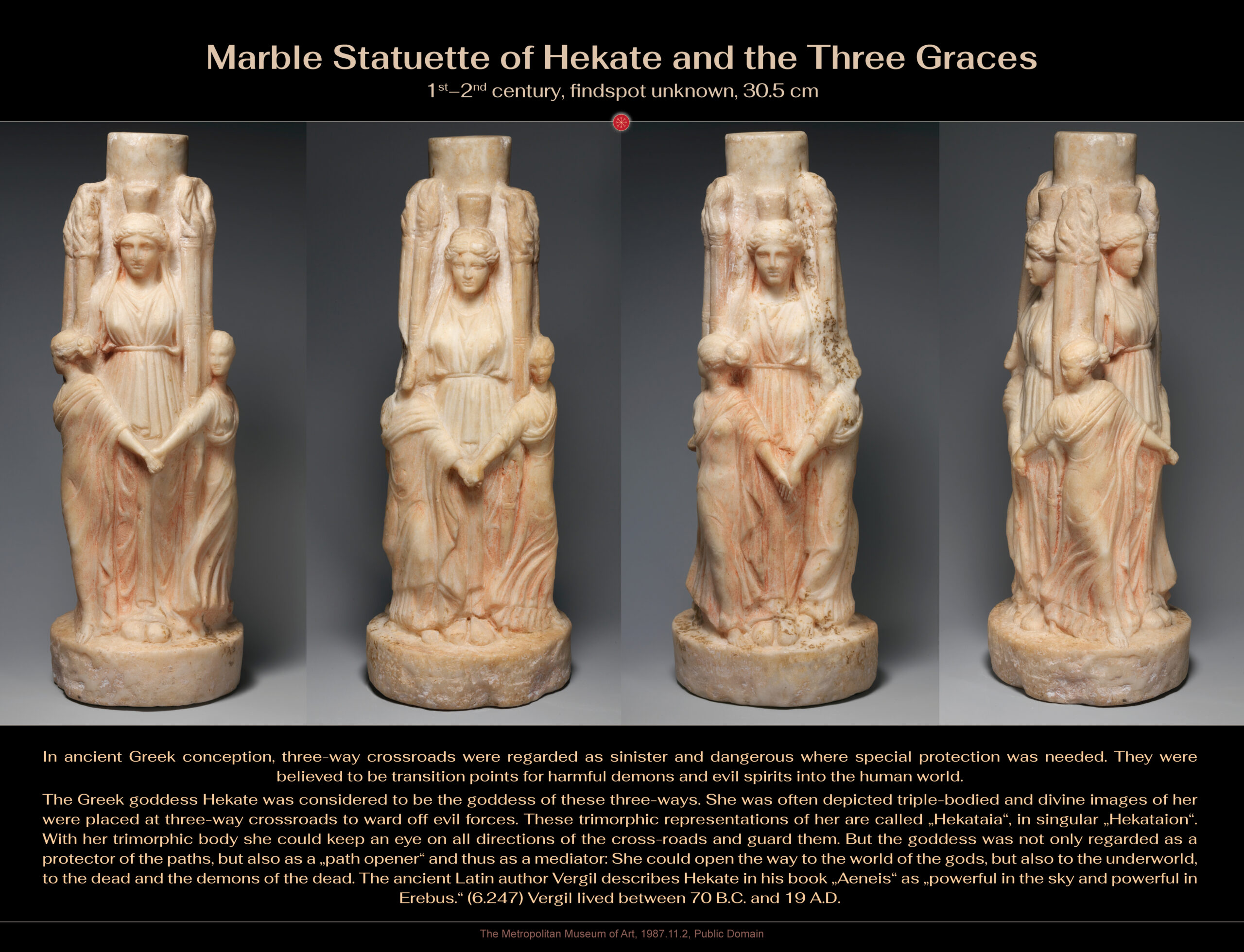
Material: Marble
Date: 1st–2nd century century
Dimensions: H: 30.5 cm (12 in.)
Findspot: unknown
Current Location: The Metropolitan Museum of Art, 1987.11.2
In ancient Greek conception, three-way crossroads were regarded as sinister and dangerous where special protection was needed. They were believed to be transition points for harmful demons and evil spirits into the human world.
The Greek goddess Hekate was considered to be the goddess of these three-ways. She was often depicted triple-bodied and divine images of her were placed at three-way crossroads to ward off evil forces. These trimorphic representations of her are called „Hekataia“, in singular „Hekataion“. With her trimorphic body she could keep an eye on all directions of the cross-roads and guard them.
But the goddess was not only regarded as a protector of the paths, but also as a „path opener“ and thus as a mediator: She could open the way to the world of the gods, but also to the underworld, to the dead and the demons of the dead.
The ancient Latin author Vergil describes Hekate in his book „Aeneis“ as „powerful in the sky and powerful in Erebus.“ (6.247) Vergil lived between 70 B.C. and 19 A.D.
Become my patron for more infographics, research and videos: https://www.patreon.com/ancientmagic