
Material: Papyrus, ink
Date: 6th-7th century
Dimensions: 37.3 x 25.4 cm
Findspot: Egypt
Current Location: Yale University Library, Beinecke Rare Book and Manuscript Library, Papyrus Collection, P.CtYBR inv. 1791
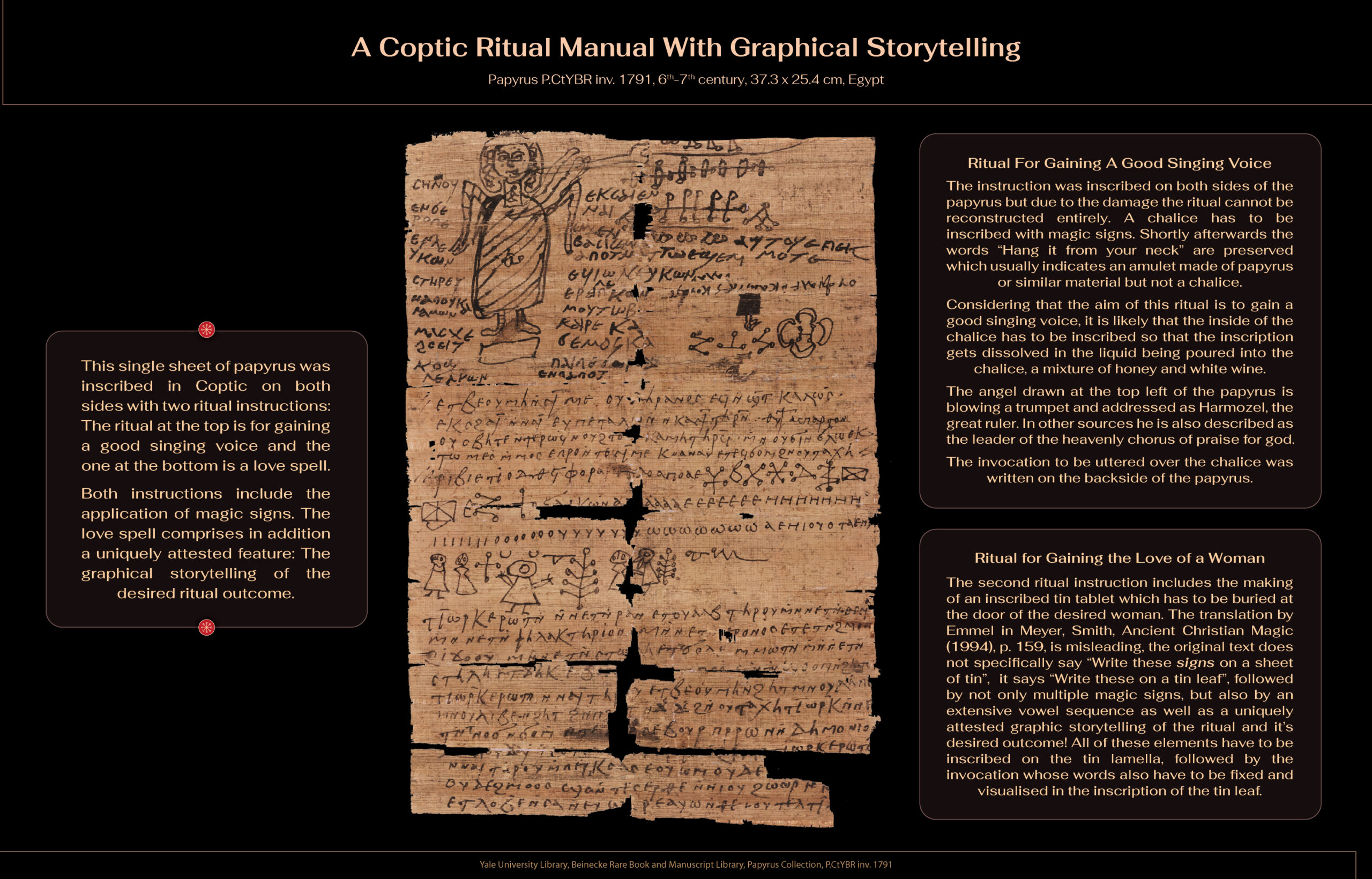
This single sheet of papyrus was inscribed in Coptic on both sides with two ritual instructions: The ritual at the top is for gaining a good singing voice and the one at the bottom is a love spell.
Both instructions include the application of magic signs. The love spell comprises in addition a uniquely attested feature: The graphical storytelling of the desired ritual outcome.
At the top: Ritual For Gaining A Good Singing Voice
The instruction was inscribed on both sides of the papyrus but due to the damage the ritual cannot be reconstructed entirely. A chalice has to be inscribed with magic signs. Shortly afterwards the words “Hang it from your neck” are preserved which usually indicates an amulet made of papyrus or similar material but not a chalice.
Considering that the aim of this ritual is to gain a good singing voice, it is likely that the inside of the chalice has to be inscribed so that the inscription gets dissolved in the liquid being poured into the chalice, a mixture of honey and white wine.
The angel drawn at the top left of the papyrus is blowing a trumpet and addressed as Harmozel, the great ruler. In other sources he is also described as the leader of the heavenly chorus of praise for god.
The invocation to be uttered over the chalice was written on the backside of the papyrus.
At the bottom: Ritual for Gaining the Love of a Woman
The second ritual instruction includes the making of an inscribed tin tablet which has to be buried at the door of the desired woman. The translation by Emmel in Meyer, Smith, Ancient Christian Magic (1994), p. 159, is misleading, the original text does not specifically say “Write these signs on a sheet of tin”, it says “Write these on a tin leaf”, followed by not only multiple magic signs, but also by an extensive vowel sequence as well as a uniquely attested graphic storytelling of the ritual and it’s desired outcome! All of these elements have to be inscribed on the tin lamella, followed by the invocation whose words also have to be fixed and visualised in the inscription of the tin leaf.
Did you find this article useful and would you like to read more about the archaeology of ancient magic? I am a freelance archaeologist making academic research accessible for free to a broad audience. You can support me with a one time donation via paypal (paypal.me: https://www.paypal.com/paypalme/kirstendzwiza) or get access to more content and my monthly live online Thoth & Maat Lectures on patreon: https://www.patreon.com/ancientmagic