
Material: Papyrus
Date: 3rd century A.D.
Dimensions: ca. 80 x 33,5 cm
Findspot: Egypt
Current Location: Left part: Muzeum Narodowe, Warsaw, Eastern Christian Art, inv. no 140159, with kind permission; Right part: Staatliche Museen zu Berlin, Antikensammlung
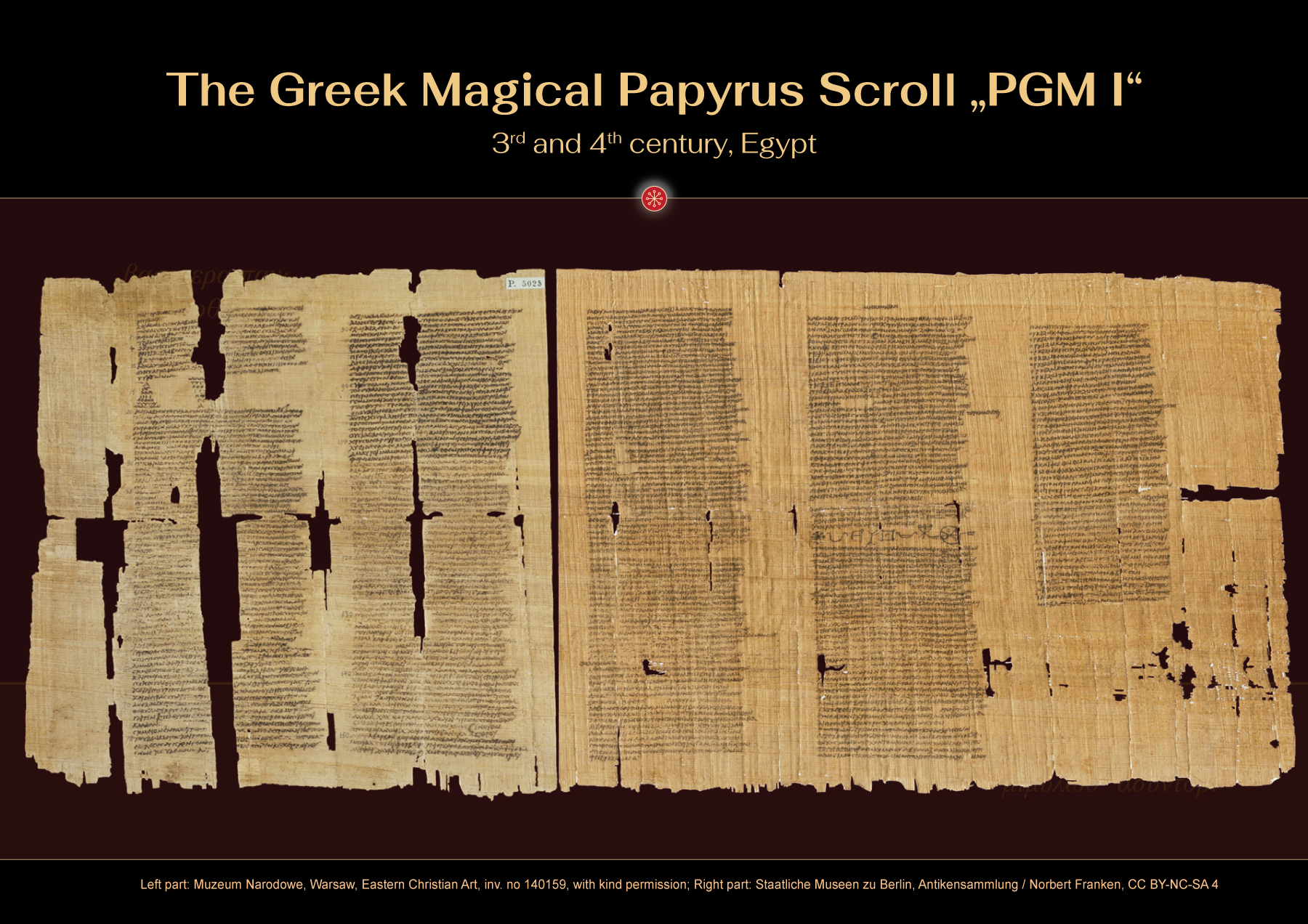
Left part: Muzeum Narodowe, Warsaw, Eastern Christian Art, inv. no 140159, with kind permission; Right part: Staatliche Museen zu Berlin, Antikensammlung / Norbert Franken, CC BY-NC-SA 4
PGM I is a short ritual manual inscribed on one side only with 347 lines in Greek. It measures ca. 80 x 33,5 cm and was made of a single papyrus sheet.
The owner of this scroll was especially interested in divination rituals, invoking divine assistants, and spells for invisibility. It comprises one of the most powerful practices in Graeco-Egyptian magic: A ritual for gaining a divine assistant whose powers are beyond anything else we know from the magical papyri. Think of a genie in a bottle but without the restriction to three wishes.
When we take a closer look at the very left and the very right end of the papyrus we can see that there has been more space left blank than between the individual columns. This, in combination with the straight vertical edges, seems to indicate that the scroll is actually completely preserved.
The papyrus was cut into two parts in modern times and they were both initially kept at the “Egyptian Museum and Papyrus Collection” in Berlin (Germany). Following WW2, the first part of the papyrus was transferred to the National Museum in Warsaw, the capital of Poland where it is still kept today.
The dating of this ritual manual is debated.
While earlier scholars assumed a timeframe between the fourth and fifth century, it has recently been re-dated to the second half of the third century, based on new palaeographical insights. The scroll was found in Egypt but the exact findspot is unknown.
Left part: Muzeum Narodowe, Warsaw, Eastern Christian Art, inv. no 140159, with kind permission; Right part: Staatliche Museen zu Berlin, Antikensammlung / Norbert Franken, CC BY-NC-SA 4
Did you find this article useful and would you like to read more about the archaeology of ancient magic? I am a freelance archaeologist making academic research accessible for free to a broad audience. You can support me with a one time donation via paypal (paypal.me: https://www.paypal.com/paypalme/kirstendzwiza) or get access to more content and my monthly live online Thoth & Maat Lectures on patreon: https://www.patreon.com/ancientmagic