
In last sunday’s lecture we discussed the partially destroyed Bear Ritual in the encrypted Greek ritual manual “PGM LVII / LXXII” (ca. late first to late second century). At one point in the invocation the practitioner threatens various gods:
[…] Accomplish for him, the NN, however many things I wrote for you on [this (papyrus strip)], and I will leave east and west [where formerly] they stood, and I [will spare] the flesh (or the corpse) of Typhon […] and I will not break apart [the] bonds by which you bound Osiris, and I will not call to the violent dead, but I will leave them undisturbed. And I will not pour out the cedar-oil but will spare it, and I will save Amun and will not murder [him] and I will [not] scatter Osiris’ limbs, and I will hide you from [the] Giants:
Ei Ei Ei Ei [Ei] Ei Ei Ei Choith Saphouth Chenthoneu Aphouth Anouaôth Ei Ei Ei Peooe Iakôb Mannoch Arannouth Chalôaph Koulix Noê N[…]k Bornath Loubeine Harouêr Oueire Itinlotol.
Translation following A. Maravela in: Faraone and Torallas-Tovar, Greek and Egyptian Magical Formularies, vol. 1, pp. 33-41.
Since the text before this invocation is lost, we do not know which higher power is addressed in “accomplish for him” and “I will hide you from [the] Giants”. Note that the “Giants” here “are not the Giants familiar from Greek mythology but a translation of the Eg. ꜥpꜥp /ⲁⲫⲟⲫⲓ, the many-bodied manifestation of the foe of Ra, Apopis. Diodorus (1.26.6–7) credits the Egyptians with a conception of the Giants as creatures of many bodies who were defeated by Osiris and his fellow-gods” (Maravela, p. 39, note 27).
Threatening higher powers is a common ritual element in the Graeko-Egyptian magical papyri. Our discussion initially concerned the question of a potential contradiction of the mythological events and then moved on to the fundamental question: Why would any ancient practitioner utter threats – especially of this cosmic dimension – against higher powers? One common interpretation in modern scholarship is: In order to communicate their (the practitioner’s) power to the invoked higher powers.
There is more to it. Iamblichus addresses this exact question in On the Mysteries, Book VI, 5-7. He offers three explanations which are very illuminationg. Here is the most recent translation by Emma C. Clark, John M. Dillon and Jackson P. Hershbell (Iamblichus, On the Mysteries, 2003, 284-289). Underlined words mark my own translations varying from Clark et. al.. In these cases I added the Greek term in the original text as well a its translations in brackets. I structured the following text so that before each explanation by Iamblichus I provide a short summary of it.
Iamblichus, Book VI, 5 So, then, let us turn our attention to another set of problems, the explanation of which is obscure. As you say, (another type of divination) involves violent threats, and the nature of the threats is very varied. For it threatens either to burst the heavens or to reveal the secrets of Isis or to divulge the arcane object in Abydos, or to halt the (sacred) barque or scatter the limbs of Osiris for Typhon, or do something else of this kind.
Explanation 1:
The threat is addressed towards a “class of powers in the cosmos” that is “at once stirred up and startled when threats are brandished at them”
However, human beings do not, as you think, hold out this entire class of discourse as a threat to the sun and the moon or any of the celestial gods (for that would produce even more outrageous consequences than those which you complain of) but, as I remarked earlier, there exists a certain class (γενος) of powers (δυναμενων) in the cosmos – limited, devoid of judgement and highly irrational, which are capable of receiving and obeying rational instruction from another, but neither has any understanding of its own nor distinguishes what is true or false or what is possible or impossible. It is such a class that is at once stirred up and startled when threats are brandished at them, since, it seems to me, it is in their own nature to be led by appearances and to be influenced by other things through a foolish and unstable imagination.
Explanation 2:
The threat is addressed towards “cosmic entities”, also referred to as “daimons”, “to instruct them how much, how great and what sort of power he holds”
Iamblichus, Book VI, 6 These things also have another explanation. The theurgist, through the power of secret symbols (αππορητων = ineffable, secret; συνθηματων = anything agreed upon, password, signal, sign, symbol), commands cosmic entities (κοσμικοις) no longer as a human being or employing a human soul but, existing above them in the order of the gods, uses threats greater than are consistent with his own proper essence – not, however, with the implication that he would perform that which he asserts, but using such words to instruct them how much, how great and what sort of power he holds through his unification with the gods, which he gains through knowledge of the secret signs (αππορητων (see above); συμβολων = of other devices having the same purpose, e.g. a seal-impression on wax; any token serving as proof of identity; passport or the seal thereon; a sign of an approaching storm; omen, portent; sign). One may also say this, that such daemons (δαιμονες) are allotted partial administrative power, and guard the parts of the universe; they are attentive to the part over which they each preside to the extent that they cannot allow a word said against it, and their concern is to preserve the eternal permanence of the things unchanging in the world. Moreover, they have taken on the task of maintaining this changelessness because the order of the gods remains immovably the same. Held as they are in this state, then, the aerial and terrestrial daemons cannot endure even to hear threats against it.
Explanation 3:
The threat is addressed towards “terrestrial daemons” containing “the orderly arrangement in the world” which “assume guardianship over the secret mysteries” and “cannot endure even hearing the suggestion that there could be any alteration or desecration”
Iamblichus, Book VI, 7 Or this may also be explained as follows. Daemons assume guardianship over the secret mysteries (απορρητοων μυστηριων), because, to a remarkable extent, they primarily contain the orderly arrangement in the world. For it is for this reason that the parts of the universe remain in order, because the beneficent power of Osiris remains sacred and immaculate and is not mingled with the opposing confusion or disorder; and the life of all things remains pure and incorruptible, since the concealed (αποκρυφα) vivifying beauties of the divine utterance (λογων = rule, principle, law; formula; utterance; divine utterance) of Isis do not descend into apparent and visible body. Rather, all things continue immovable and eternal, because the course of the sun is never halted, and all things remain perfect and entire, since the secrets (απορρητα = secret) in Abydos are never disclosed. As regards, then, that by which the safety of all is preserved (I mean in the eternal preservation of the hidden secrets (απορρητα = secret; κεκρυμμενα = hidden, concealed, occult), and in the ineffable essence of the gods, never receiving a portion of that which is contrary to it), the terrestrial daemons cannot endure even hearing the suggestion that there could be any alteration or desecration, and this is why this manner of address holds some power over them.
But no one threatens the gods, nor does such a manner of invocation occur in relation to them. Hence, among the Chaldaeans, by whom language used for the gods alone is preserved in its purity, threats are never uttered. The Egyptians, however, who combine addresses to daemons with divine symbols (xxx), do sometimes use threats. Thus you have an answer to these difficulties which is brief but, I think, sufficiently clear.
I think explanations number 2 and 3 are most likely in the contexts of the invokation in the Bear Ritual in the encrypted Greek ritual manual “PGM LVII / LXXII”.
This is a photo of the invocation comprising the threats against higher powers:
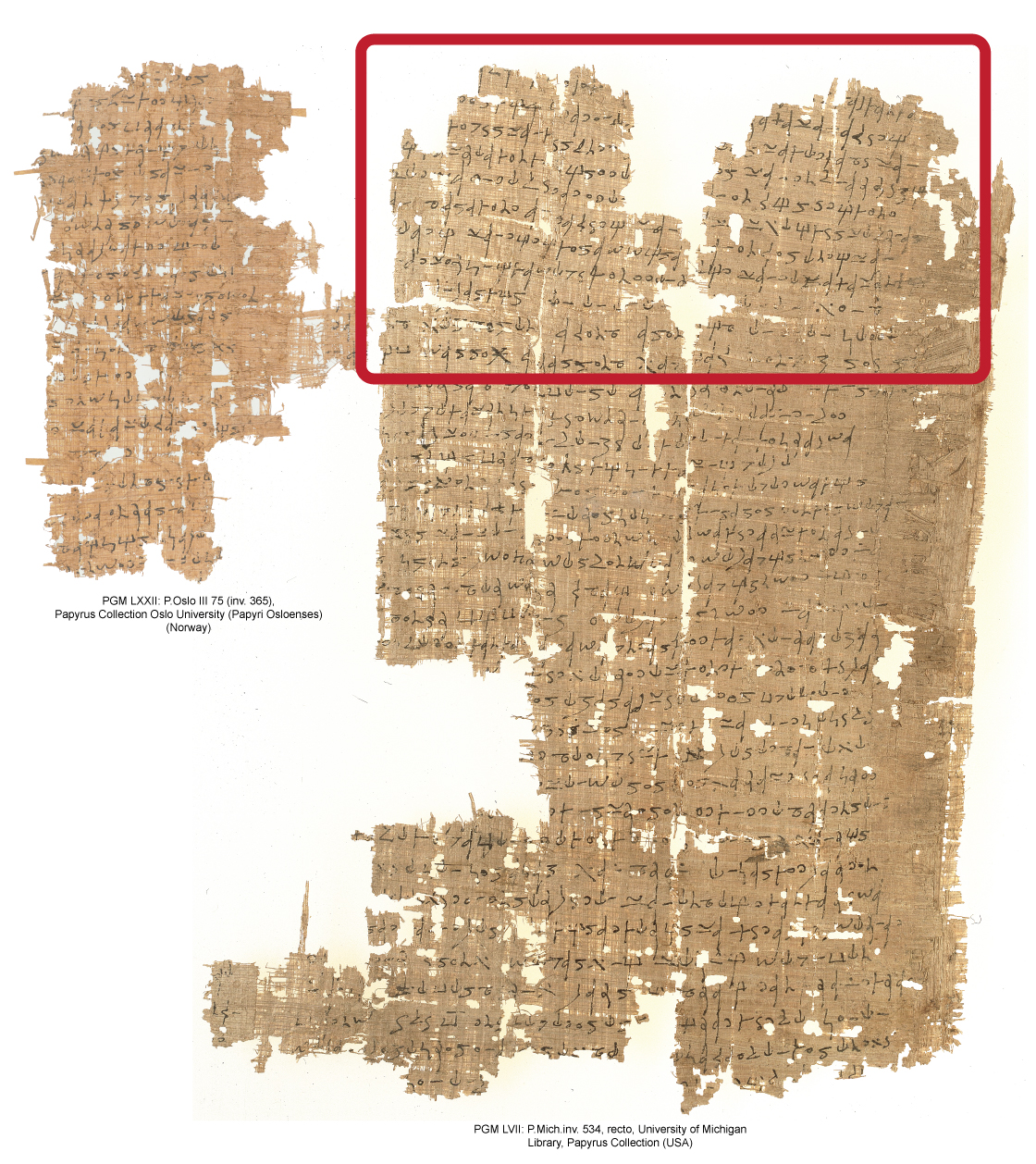
Links to the two papyri:
PGM LXXII = P.Oslo III 75 (inv. 365): https://ub-baser.uio.no/opes/record/240
PGM LVII = P.Mich.inv. 534: https://quod.lib.umich.edu/a/apis/x-2437/534r___tif
Did you find this article useful and would you like to read more about the archaeology of ancient magic? I am a freelance archaeologist making academic research accessible for free to a broad audience. You can support me with a one time donation via paypal (paypal.me: https://www.paypal.com/paypalme/kirstendzwiza) or get access to more content and my monthly live online Thoth & Maat Lectures on patreon: https://www.patreon.com/ancientmagic